 PingNet
PingNet
PingNet

Local-first • Trust-aware • Built for degraded environments
PingNet helps prevent crashes and save lives by enabling direct safety communication, even when cellular networks, GPS or roadside units fail. Between vehicles, infrastructure and people without relying on continuous connectivity.
No continuous connectivity required. Built to complement existing mobility systems with resilient local messaging and trust verification.
Veteran-led • Built on real-world mission-critical communications experience • Designed for public-safety deployment
AV and driver-assist systems depend on cloud services, cellular towers, GPS and roadside units. In dense cities, remote regions or severe weather, these links may not be available when safety decisions are needed most. PingNet maintains secure, local safety communication across vehicles, infrastructure and people — providing continuity when conditions become unpredictable.
PingNet has already been demonstrated using a multi-node Raspberry Pi testbed. The MVP validates local hazard propagation, role-aware message exchange, and mesh-style communication between participants in a degraded-environment safety scenario.
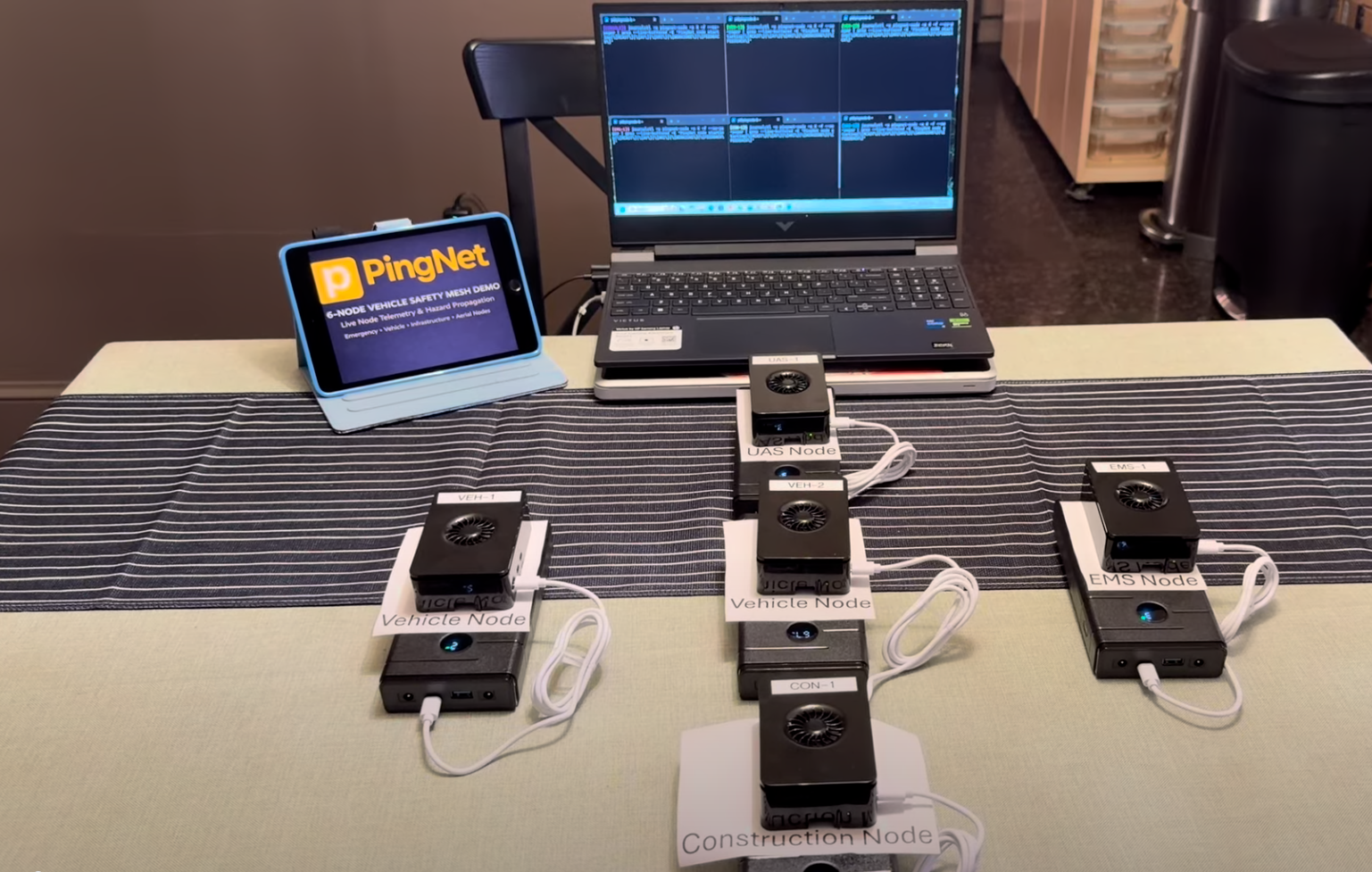
Six-node PingNet MVP testbed demonstrating vehicle, EMS, construction, and UAS nodes participating in a local safety mesh. The sixth node functions as the console and map visualization system. The sixth node is not pictured.
Warn nearby vehicles about fog, black ice or debris early, enabling drivers and automated systems to slow, reroute or brake sooner.
Improve safety around active work zones by helping vehicles respond to lane shifts, speed reductions and worker presence; reducing conflicts and near-misses.
Maintain shared situational awareness between air and ground assets during incidents, enabling safer coordination in beyond-visual-line-of-sight and autonomy scenarios.
Feed local safety signals into traffic control and city operations to support Vision Zero and real-time response.
Identify high-risk situations earlier using shared motion and hazard context, supporting faster response and crash reduction.
Create a shared situational picture from lightweight local insights to inform both real-time decisions and long-term planning.
PingNet’s development has been informed by interviews with transportation leaders, industry experts, and everyday drivers to better understand the real challenges facing connected vehicle deployment.
The resulting research identified recurring barriers such as low vehicle equipage, funding constraints, standards uncertainty, and the importance of trusted, context-aware alerts.
Research has highlighted familiar barriers: low equipage, funding constraints, standards uncertainty, and the need for interoperable rollout paths.
Interviews consistently pointed to the importance of authenticated, context-aware alerts with clear privacy boundaries and low false-alarm rates.
The strategic path forward is phased: start with pilots, prove value, iterate with stakeholders, and expand through partnerships.
PingNet is being designed around degraded-environment operation, trust verification, and failure-mode resilience — not best-case connectivity assumptions.
The project combines real stakeholder discovery, a working multi-node MVP, and a defined transition path from pilot software to a hardened production runtime.
A public architecture overview is available for collaborators and engineers who want a technical understanding of the problem space and system direction.
Founder & Lead Engineer, PingNet
U.S. Army veteran • Senior SIGINT & Cyber Analyst
Jonathan brings real-world mission-critical communications experience to public-safety technology. Trained at the Defense Language Institute and deployed in high-risk environments, he worked on ensuring clear, trusted communication when failure had immediate consequences. Those experiences shaped PingNet’s core philosophy: systems must work in degraded conditions, and trust must be built into the network itself. Today, Jonathan applies the same discipline to building a resilient safety communication layer designed to prevent crashes and save lives.
He is currently leading PingNet’s product direction, prototyping, customer discovery, and technical architecture as the company prepares for pilots and production hardening.
jonathan.garrettjr@pingnet.net
+1 202 656-5639
LinkedIn Profile
GitHub Profile
Based in Washington, D.C. • Provisional patents filed
PingNet is in an active research, prototyping, and discovery phase. We’re inviting transportation agencies, fleet operators, OEMs, engineers, and community safety advocates to explore pilots and partnerships that advance Vision Zero and connected-mobility resilience.