Local message delivery
Equipped, participating PingNet nodes exchange messages through a local communications layer.

Local-first communications for work zones
PingNet is developing local-first, authenticated communications for equipped, participating work-zone and fleet nodes. The prototype has completed controlled tabletop tests. The next step is to define a narrowly scoped, customer-funded work-zone feasibility evaluation with an operator and seek bounded independent technical review.
The results on this page come from controlled tabletop tests. They do not represent a public-road deployment or production certification.
Patent pending. U.S. provisional patent application filed for PingNet's V2X redundancy architecture.
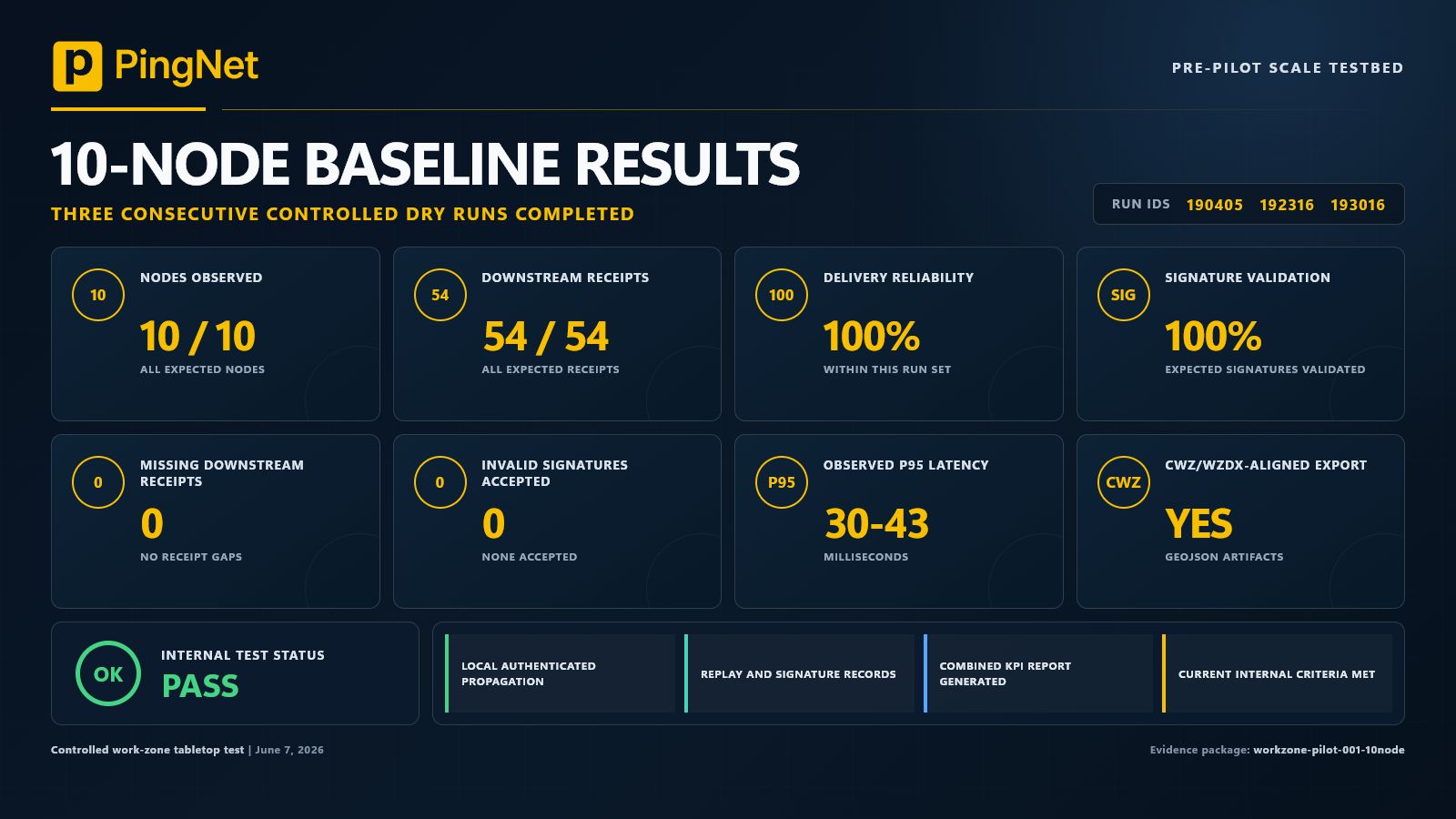
These observations come from three controlled ten-node tabletop runs completed on June 7, 2026. They are not pooled field-performance statistics.
The need
In a work zone, people work close to traffic while drivers approach changing conditions. PingNet is being developed to move signed messages among equipped, participating PingNet nodes when normal connectivity is weak or unavailable.
The local real-time path does not require a cloud connection. PingNet is intended as a complementary path, but interoperability and automatic failover with existing vehicle or roadside systems have not been demonstrated.
Equipped, participating PingNet nodes exchange messages through a local communications layer.
Participating nodes validate signed content under the configured trust model before accepting or relaying it. This does not verify that the reported hazard is true.
The prototype records receipts, signature checks, and latency. Selected logs can be mapped after a run into CWZ/WZDx-aligned GeoJSON artifacts.
Post-run WorkZoneFeed-style and DeviceFeed-style GeoJSON artifacts derived from selected test logs. Geometry may be modeled unless explicitly field verified.
Partner-specific interfaces that fit an operator's existing mapping and information workflows.
Formal CWZ/WZDx conformance, a live agency feed, native OEM, C-V2X, DSRC, or SCMS interoperability, or universal device compatibility.
Tabletop demonstration
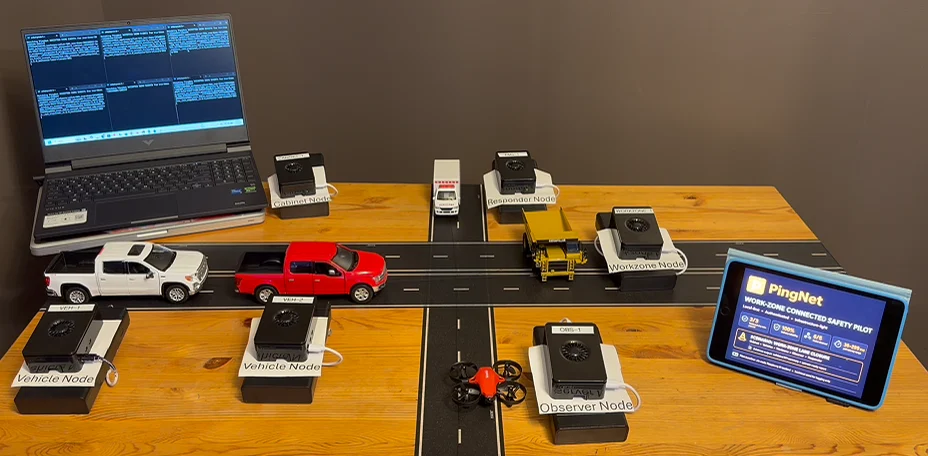
The six-node demonstration follows an active lane-closure message from the work-zone source through signature validation and receipt by participating nodes. The KPI results come from three separate ten-node tabletop runs.
WORKZONE-1 sends an active lane-closure message. Vehicle, roadside-infrastructure, observer, and emergency-response nodes receive it and verify its signature. This is a tabletop demonstration, not a public-road deployment.
Measured evidence
On June 7, 2026, PingNet completed three controlled ten-node tabletop runs. Each run observed 10 of 10 expected nodes. Across the three runs, 54 of 54 expected downstream receipts were delivered, and reported signature validation was 100%. The figures below apply only to those runs.
Roadmap
The work-zone use case is the immediate focus. Later expansion depends on evidence, operator needs, resources, and authorization.
Scoped evaluation customers
PingNet is seeking an operator or contractor for a bounded, customer-funded feasibility evaluation. Scope, authorization, safety responsibilities, measurements, success criteria, and stop criteria would be agreed before field work.
Define the scenario, intended recipients, site permissions, and safety responsibilities.
Map the current workflow, interfaces, operating conditions, and success criteria.
Review the technical scope, measurements, integration needs, and after-action evidence.
 Historical research with context, PDF
Historical stakeholder research
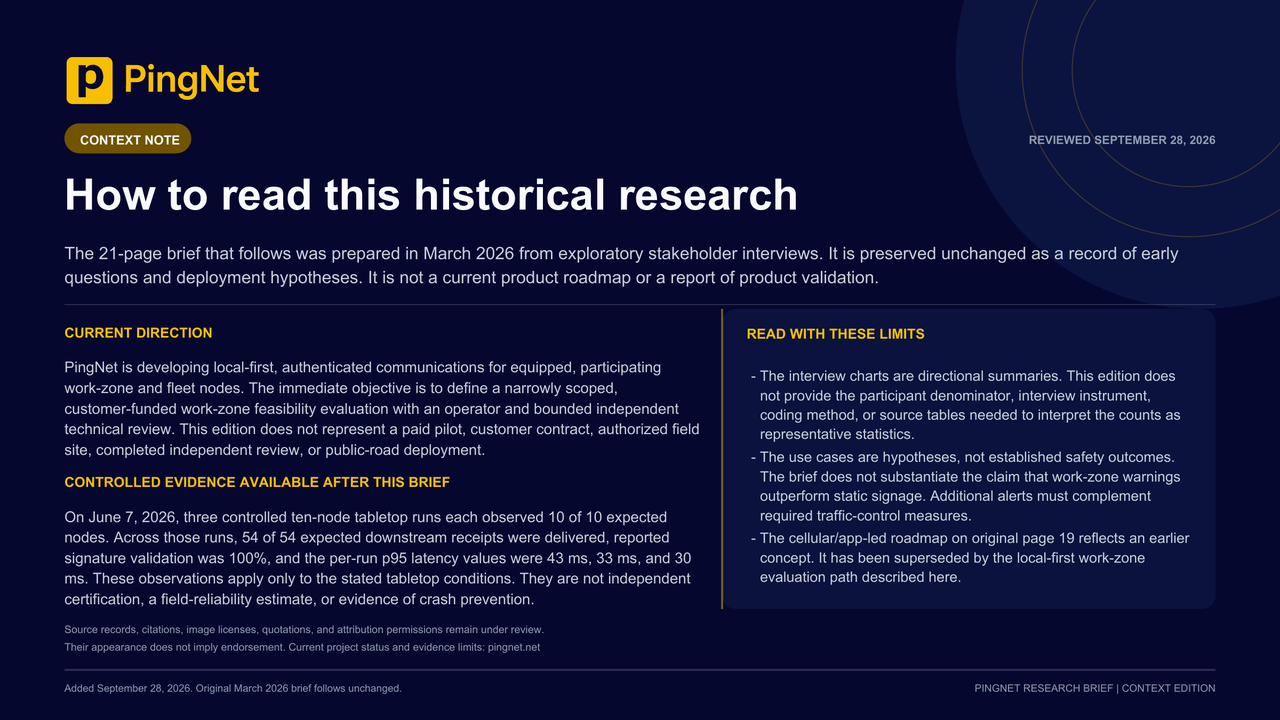
This March 2026 brief records an early interview-based research effort with transportation leaders, industry professionals, and drivers. It predates PingNet's current local-first work-zone direction and is not product validation or a current implementation roadmap.
Context reviewed September 28, 2026. Interview findings do not establish product performance or safety outcomes. The technical results on this page come from separate tabletop tests.
Read the context edition
About the founder
Jonathan Garrett Jr. is a U.S. Army veteran who currently works as a SIGINT and cyber operator. His background includes electronic warfare and secure communications.
Alongside that work, he is building PingNet to bring authenticated local communications to V2X safety. The immediate focus is preparing a scoped work-zone feasibility evaluation with an operator and seeking bounded independent technical review.
Scoped work-zone evaluation
Work-zone operators, fleet and public-works teams, transportation agencies, and appropriate contractors can bring one concrete problem. Together we can define the scenario, intended recipients, current workflow, site and safety permissions, success and stop criteria, and the evidence needed for an after-action report.